Every solar quote comes down to panels — but the component that quietly decides how safe, reliable, and productive your system will be for the next 25 years is the inverter. It's the piece of equipment that converts the DC power your panels make into the AC power your home uses. There are two ways to do it, and the difference matters more than most homeowners realize.
String inverters: the old way
Traditional systems wire every panel together in a chain (a "string") that feeds one central inverter box on the side of your house. It's cheaper hardware, but the design has three built-in weaknesses:
- One panel drags down the whole string. Shade from a chimney, a leaf, or afternoon tree cover on a single panel reduces the output of every panel in the chain.
- A single point of failure. When the central inverter goes down — and they typically need replacement after 10–12 years — your entire system produces nothing until it's fixed.
- High-voltage DC on your roof. String designs can carry up to 1,000 volts DC across the rooftop wiring.
Microinverters: one under every panel
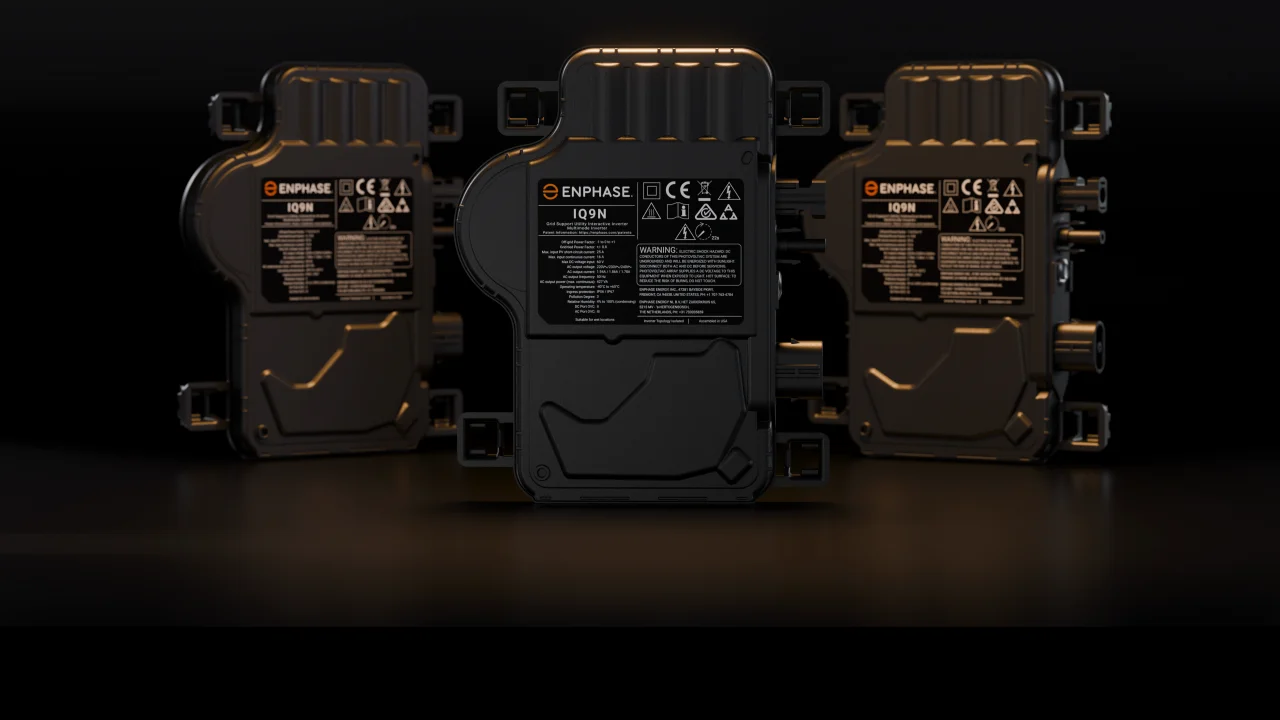
A microinverter is a compact, sealed inverter mounted on the racking directly beneath each panel. The DC-to-AC conversion happens right there, panel by panel. That single design change fixes all three weaknesses at once:
- Every panel performs independently. Shade on one panel costs you that panel's output for that hour — nothing more. On the complex rooflines and mature-tree lots common across Southern California, that routinely means more lifetime energy from the same roof.
- No single point of failure. If one microinverter ever has a problem, the other panels keep producing while it's swapped out.
- Safer by design. The roof carries standard low-voltage AC (240V) instead of up to 1,000V DC, and every unit supports rapid shutdown — a feature firefighters specifically look for.
- Built for 25 years outdoors. The units we install are sealed in double-insulated polymer housings rated NEMA 6 / IP67 and carry a 25-year limited warranty — matched to your panels, versus the 10–12 years typical of a string inverter.
- Panel-level monitoring. You see the production of every individual panel from your phone, so nothing can quietly underperform for months unnoticed.
The equipment we install
ENP America installs microinverters from Enphase, the world's leading microinverter manufacturer — including the proven IQ8 series and the new IQ9 generation, built on gallium nitride (GaN) technology that converts power more efficiently and runs cooler for longer life. These units are built in American factories in South Carolina, Texas, and Wisconsin — and in 2026, that detail is worth real money.
Why American-made equipment still unlocks 30% federal savings
You may have heard that the 30% federal solar tax credit ended for homeowner-purchased systems on December 31, 2025. That's true — but it's only half the story. A second federal credit (Section 48E) survived for solar programs where the provider owns the system, and under the 2026 rules, qualifying for it now hinges on domestic content: systems must be built substantially from American-made equipment to capture the full credit.
Here's what that means for you: because the equipment we install is American-made and meets the new domestic-content requirements, ENP America's program still captures the full 30% federal savings and passes it through to you — even in 2026, after the old homeowner credit expired. Installers relying on imported equipment can't make that offer.
The window isn't indefinite — federal deadlines currently run through 2027 — so if you've been waiting for the "right time" since the old credit expired, the American-made path is the door still standing open. For the full policy picture, see our guide to your 2026 options after the federal tax credit.
The bottom line
Microinverters cost slightly more per watt than string hardware, and for most California homes they're worth every penny: more energy from shaded and complex roofs, no single point of failure, a 25-year warranty on the whole system, and panel-by-panel visibility from your phone. Combined with American-made equipment that keeps 30% federal savings on the table, it's the architecture we'd put on our own homes — so it's the only one we install.
Curious what a microinverter system would produce on your specific roof? Get an instant answer from the free estimator or talk to an advisor.